Lektion 9/10 · 15 Wörter · 0 gelernt
Nervous system
Nervensystem
das Kleinhirn, das Cerebellum
the part of the brain at the back of the head, below the cerebrum, that controls balance and coordination
A stroke in the cerebellum can cause unsteady walking.
Ein Schlaganfall im Kleinhirn kann einen unsicheren Gang verursachen.
Alcohol temporarily affects the cerebellum, so drunk people lose their balance.
Synonymehindbrain structurecerebellar structureAntonymecerebrumdas Großhirn, das Cerebrum
the largest part of the brain, made of two hemispheres, which controls thinking, memory, speech and voluntary movement
The cerebrum is divided into left and right hemispheres.
Das Großhirn ist in eine linke und eine rechte Hemisphäre unterteilt.
Damage to the cerebrum can affect speech and movement.
SynonymebrainforebrainAntonymecerebellumbrainstemder Hirnnerv
one of the 12 pairs of nerves that come directly from the brain and supply mainly the head and neck
The facial nerve is the seventh cranial nerve.
Der Nervus facialis ist der siebte Hirnnerv.
We test all twelve cranial nerves during a full neurological examination.
Synonymebrain nervehead nerveAntonymespinal nerveperipheral nervedie Meningen, die Hirn- und Rückenmarkshäute
the three protective membranes that cover the brain and spinal cord
Meningitis is an infection of the meninges and needs urgent treatment.
Die Meningitis ist eine Entzündung der Meningen und muss dringend behandelt werden.
The CT scan showed blood between the layers of the meninges.
Synonymedura materarachnoid materpia materAntonymebrainspinal corddie Synapse
the tiny gap between two nerve cells, or a nerve and a muscle, where signals pass from one to the other
When a signal arrives, neurotransmitters are released into the synapse.
Wenn ein Signal eintrifft, werden Neurotransmitter in die Synapse freigesetzt.
Many drugs work by changing how signals cross the synapse.
SynonymeNeural junctionJunctionConnectionNeural linkAntonymeDisconnectionGapSeparationdas Neuron, die Nervenzelle
a nerve cell that sends and receives electrical and chemical signals
Motor neurons carry signals from the spinal cord to the muscles.
Motoneuronen leiten Signale vom Rückenmark zu den Muskeln.
Parkinson's disease involves the loss of neurons that produce dopamine.
Synonymenerve celldas Rückenmark
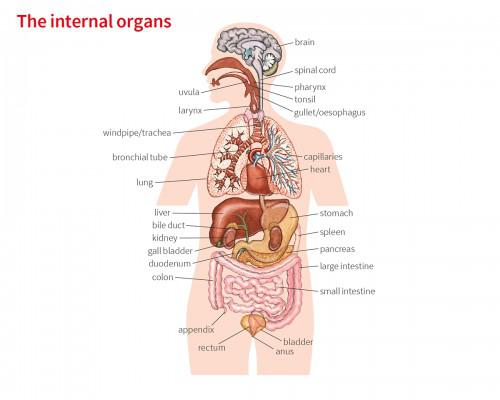
the long bundle of nerve tissue inside the spine that carries messages between the brain and the body
A spinal cord injury in the neck can paralyze all four limbs.
Eine Rückenmarksverletzung im Halsbereich kann alle vier Gliedmaßen lähmen.
In adults, the spinal cord ends at about the level of the first lumbar vertebra.
Synonymeneural tubespinal marrowdas Axon, der Neurit
the long, thin part of a nerve cell that carries signals away from the cell body
Many axons are covered by a fatty layer called myelin.
Viele Axone sind von einer Fettschicht namens Myelin umhüllt.
Damage to the axon slows down nerve conduction.
Synonymenerve fibernerve processAntonymedendriteder Neurotransmitter, der Botenstoff
a chemical released by a nerve cell that carries signals across a synapse, such as dopamine or serotonin
Acetylcholine is the neurotransmitter that activates skeletal muscle.
Acetylcholin ist der Neurotransmitter, der die Skelettmuskulatur aktiviert.
Some antidepressants increase levels of the neurotransmitter serotonin.
Synonymechemical messengersignaling moleculeAntonymeNoneder Liquor cerebrospinalis, der Liquor, das Hirnwasser
the clear fluid that surrounds and protects the brain and spinal cord; CSF
A lumbar puncture collects cerebrospinal fluid for testing.
Bei einer Lumbalpunktion wird Liquor zur Untersuchung entnommen.
Cloudy cerebrospinal fluid with many white cells suggests bacterial meningitis.
SynonymeCSFneural fluiddas Zentralnervensystem, das ZNS
the brain and spinal cord, which receive information and control the body's activities; the CNS
Multiple sclerosis damages the myelin in the central nervous system.
Multiple Sklerose schädigt das Myelin im Zentralnervensystem.
This drug enters the central nervous system and can cause drowsiness.
das periphere Nervensystem
all the nerves outside the brain and spinal cord that connect them with the rest of the body
Diabetes can damage the peripheral nervous system and cause numb feet.
Diabetes kann das periphere Nervensystem schädigen und taube Füße verursachen.
The peripheral nervous system carries signals between the limbs and the spinal cord.
das vegetative Nervensystem, das autonome Nervensystem
the part of the nervous system that controls automatic functions such as heart rate, digestion and sweating
The autonomic nervous system has sympathetic and parasympathetic divisions.
Das vegetative Nervensystem besteht aus einem sympathischen und einem parasympathischen Anteil.
Some fainting episodes are caused by a problem with the autonomic nervous system.
der Hirnstamm
the lowest part of the brain, connecting it to the spinal cord and controlling breathing and heart rate
The brainstem controls vital functions such as breathing.
Der Hirnstamm steuert lebenswichtige Funktionen wie die Atmung.
Two senior doctors carried out the tests for brainstem death.
die Großhirnrinde, der Kortex
the thin outer layer of gray matter of the cerebrum, responsible for thinking, language and voluntary movement
The motor area of the cerebral cortex controls voluntary movement.
Das motorische Areal der Großhirnrinde steuert die willkürliche Bewegung.
In Alzheimer's disease, the cerebral cortex gradually shrinks.