บทที่ 3/10 · 15 คำ · จำได้แล้ว 0
Cells and tissues
เซลล์และเนื้อเยื่อ
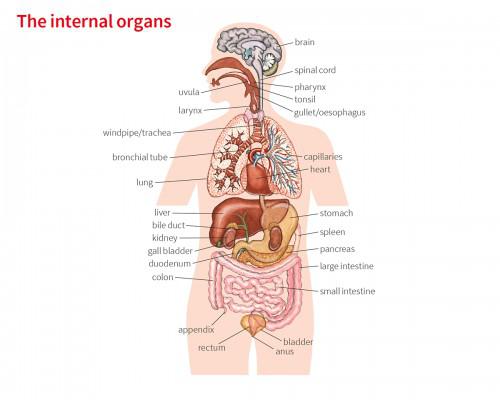
อวัยวะ
a part of the body made of several tissues that performs a particular function, such as the heart or liver
The liver is the largest internal organ in the body.
ตับเป็นอวัยวะภายในที่ใหญ่ที่สุดในร่างกาย
Severe sepsis can lead to multiple organ failure.
คำพ้องความหมายbody partmemberinstrumentpublicationvehicleagencyคำตรงข้ามwholeentiretyinanimate objectคอลลาเจน
the main structural protein in skin, bone, tendons and other connective tissues
Tightly packed collagen fibers give tendons their great strength.
เส้นใยคอลลาเจนที่เรียงตัวแน่นทำให้เส้นเอ็นมีความแข็งแรงมาก
Collagen production in the skin decreases with age.
คำพ้องความหมายproteinstructural proteinคำตรงข้ามNone (Collagen does not have a direct antonym. Focus is on things that degrade/inhibit it)เนื้อเยื่อเกี่ยวพัน
tissue that supports, connects and protects other tissues and organs, such as bone, cartilage, fat and tendons
Tendons and ligaments are made of dense connective tissue.
เอ็นกล้ามเนื้อและเอ็นยึดข้อประกอบด้วยเนื้อเยื่อเกี่ยวพันชนิดแน่น
Lupus is a disease that mainly attacks the connective tissue.
คำพ้องความหมายsupporting tissuebinding tissueคำตรงข้ามepithelial tissuenervous tissuemuscle tissueไซโทพลาซึม
the jelly-like material inside a cell, around the nucleus, where many cell activities take place
Many chemical reactions of the cell take place in the cytoplasm.
ปฏิกิริยาเคมีหลายอย่างของเซลล์เกิดขึ้นในไซโทพลาซึม
The stain colored the cytoplasm pink and the nucleus blue.
คำพ้องความหมายprotoplasmcell substanceคำตรงข้ามnucleuscell membraneเยื่อบุผิว
the layer of cells that covers the body surface and lines organs, vessels and cavities
The epithelium of the airways is covered with tiny hairs called cilia.
เยื่อบุผิวของทางเดินหายใจมีขนเล็ก ๆ ที่เรียกว่าซิเลียปกคลุมอยู่
Most cancers, such as skin and lung cancer, begin in the epithelium.
คำพ้องความหมายtissue liningsurface layercoveringคำตรงข้ามnoneต่อม
an organ or group of cells that produces and releases substances such as hormones, sweat or saliva
The thyroid gland produces hormones that control metabolism.
ต่อมไทรอยด์ผลิตฮอร์โมนที่ควบคุมเมตาบอลิซึม
Sweat glands in the skin help to regulate body temperature.
คำพ้องความหมายorgannodeacinusคำตรงข้ามNoneเซลล์ต้นกำเนิด, สเต็มเซลล์
an unspecialized cell that can divide and develop into many different types of cell
Bone marrow contains stem cells that produce all types of blood cells.
ไขกระดูกมีเซลล์ต้นกำเนิดที่สร้างเซลล์เม็ดเลือดทุกชนิด
Researchers are testing stem cells to repair damaged heart muscle.
คำพ้องความหมายprogenitor cellmother cellคำตรงข้ามdifferentiated cellspecialized cellไมโทคอนเดรีย
a tiny structure inside a cell that produces energy from food; the plural is mitochondria
Muscle cells contain many mitochondria because they need a lot of energy.
เซลล์กล้ามเนื้อมีไมโทคอนเดรียจำนวนมากเพราะต้องการพลังงานมาก
Some rare inherited diseases are caused by faulty mitochondria.
คำพ้องความหมายpowerhouseorganelleคำตรงข้ามnoneภาวะธำรงดุล, ภาวะสมดุลภายในร่างกาย
the body's ability to keep its internal conditions, such as temperature and blood sugar, stable
The kidneys play a key role in maintaining fluid homeostasis.
ไตมีบทบาทสำคัญในการรักษาภาวะธำรงดุลของของเหลวในร่างกาย
Severe illness such as sepsis can disturb the body's homeostasis.
คำพ้องความหมายequilibriumstabilitybalanceคำตรงข้ามimbalanceinstabilityเยื่อหุ้มเซลล์
the thin outer layer of a cell that controls what enters and leaves it
Small molecules such as oxygen pass easily across the cell membrane.
โมเลกุลขนาดเล็ก เช่น ออกซิเจน ผ่านเยื่อหุ้มเซลล์ได้อย่างง่ายดาย
Some antibiotics work by damaging the cell membrane of bacteria.
ออร์แกเนลล์, โครงสร้างย่อยภายในเซลล์
a small structure inside a cell that has a particular job, such as the nucleus or a mitochondrion
Each organelle performs a specific function within the cell.
ออร์แกเนลล์แต่ละชนิดทำหน้าที่เฉพาะภายในเซลล์
Electron microscopes allow us to see organelles in great detail.
เนื้อเยื่อไขมัน
body tissue that stores fat and helps to keep the body warm and protect organs
Adipose tissue is found under the skin and around internal organs.
เนื้อเยื่อไขมันพบได้ใต้ผิวหนังและรอบอวัยวะภายใน
Excess adipose tissue around the waist increases the risk of heart disease.
เยื่อเมือก, เยื่อบุเมือก
a moist layer of tissue that lines passages such as the mouth, nose and gut and produces mucus
The mucous membranes of her mouth looked pale and dry.
เยื่อเมือกในปากของเธอดูซีดและแห้ง
Viruses often enter the body through the mucous membrane of the nose.