Aralin 3/10 · 15 salita · 0 natutunan
Cells and tissues
Mga selula at tisyu
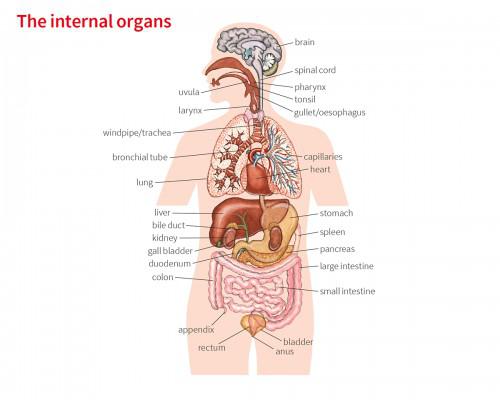
organo, sangkap ng katawan
a part of the body made of several tissues that performs a particular function, such as the heart or liver
The liver is the largest internal organ in the body.
Ang atay ang pinakamalaking panloob na organo sa katawan.
Severe sepsis can lead to multiple organ failure.
Kasingkahuluganbody partmemberinstrumentpublicationvehicleagencyKasalungatwholeentiretyinanimate objectkolagen
the main structural protein in skin, bone, tendons and other connective tissues
Tightly packed collagen fibers give tendons their great strength.
Ang mahigpit na nakapilit na mga hibla ng kolagen ang nagbibigay ng malaking lakas sa mga litid.
Collagen production in the skin decreases with age.
Kasingkahuluganproteinstructural proteinKasalungatNone (Collagen does not have a direct antonym. Focus is on things that degrade/inhibit it)nag-uugnay na tisyu, connective tissue
tissue that supports, connects and protects other tissues and organs, such as bone, cartilage, fat and tendons
Tendons and ligaments are made of dense connective tissue.
Ang mga litid at ligamento ay gawa sa siksik na nag-uugnay na tisyu.
Lupus is a disease that mainly attacks the connective tissue.
Kasingkahulugansupporting tissuebinding tissueKasalungatepithelial tissuenervous tissuemuscle tissuesitoplasma
the jelly-like material inside a cell, around the nucleus, where many cell activities take place
Many chemical reactions of the cell take place in the cytoplasm.
Maraming kemikal na reaksyon ng selula ang nagaganap sa sitoplasma.
The stain colored the cytoplasm pink and the nucleus blue.
Kasingkahuluganprotoplasmcell substanceKasalungatnucleuscell membraneepithelium, epitelyo
the layer of cells that covers the body surface and lines organs, vessels and cavities
The epithelium of the airways is covered with tiny hairs called cilia.
Ang epithelium ng mga daanan ng hangin ay may maliliit na buhok na tinatawag na cilia.
Most cancers, such as skin and lung cancer, begin in the epithelium.
Kasingkahulugantissue liningsurface layercoveringKasalungatnoneglandula
an organ or group of cells that produces and releases substances such as hormones, sweat or saliva
The thyroid gland produces hormones that control metabolism.
Ang glandula ng thyroid ay gumagawa ng mga hormone na kumokontrol sa metabolismo.
Sweat glands in the skin help to regulate body temperature.
KasingkahuluganorgannodeacinusKasalungatNoneselulang ugat, selulang pinagmulan
an unspecialized cell that can divide and develop into many different types of cell
Bone marrow contains stem cells that produce all types of blood cells.
Ang utak ng buto ay naglalaman ng mga selulang ugat na gumagawa ng lahat ng uri ng selula ng dugo.
Researchers are testing stem cells to repair damaged heart muscle.
Kasingkahuluganprogenitor cellmother cellKasalungatdifferentiated cellspecialized cellmitokondriya
a tiny structure inside a cell that produces energy from food; the plural is mitochondria
Muscle cells contain many mitochondria because they need a lot of energy.
Maraming mitokondriya ang mga selula ng kalamnan dahil nangangailangan sila ng maraming enerhiya.
Some rare inherited diseases are caused by faulty mitochondria.
KasingkahuluganpowerhouseorganelleKasalungatnonehomeostasis, panloob na balanse ng katawan
the body's ability to keep its internal conditions, such as temperature and blood sugar, stable
The kidneys play a key role in maintaining fluid homeostasis.
Malaki ang papel ng mga bato sa pagpapanatili ng homeostasis ng likido.
Severe illness such as sepsis can disturb the body's homeostasis.
KasingkahuluganequilibriumstabilitybalanceKasalungatimbalanceinstabilitylamad ng selula, membrano ng selula
the thin outer layer of a cell that controls what enters and leaves it
Small molecules such as oxygen pass easily across the cell membrane.
Madaling dumaraan sa lamad ng selula ang maliliit na molekula tulad ng oxygen.
Some antibiotics work by damaging the cell membrane of bacteria.
nukleyo, nukleyo ng selula
the central part of a cell that contains its genetic material (DNA) and controls its activity
Red blood cells lose their nucleus as they mature.
Nawawala ang nukleyo ng mga pulang selula ng dugo habang sila ay tumatanda.
Under the microscope, the cancer cells had large, dark nuclei.
organelo
a small structure inside a cell that has a particular job, such as the nucleus or a mitochondrion
Each organelle performs a specific function within the cell.
Ang bawat organelo ay may partikular na tungkulin sa loob ng selula.
Electron microscopes allow us to see organelles in great detail.
tisyung taba, tisyung adiposo
body tissue that stores fat and helps to keep the body warm and protect organs
Adipose tissue is found under the skin and around internal organs.
Matatagpuan ang tisyung taba sa ilalim ng balat at sa paligid ng mga panloob na organo.
Excess adipose tissue around the waist increases the risk of heart disease.
mukosa, membranong mukosa
a moist layer of tissue that lines passages such as the mouth, nose and gut and produces mucus
The mucous membranes of her mouth looked pale and dry.
Mukhang maputla at tuyo ang mga mukosa sa bibig niya.
Viruses often enter the body through the mucous membrane of the nose.