Leçon 3/10 · 15 mots · 0 appris
Cells and tissues
Cellules et tissus
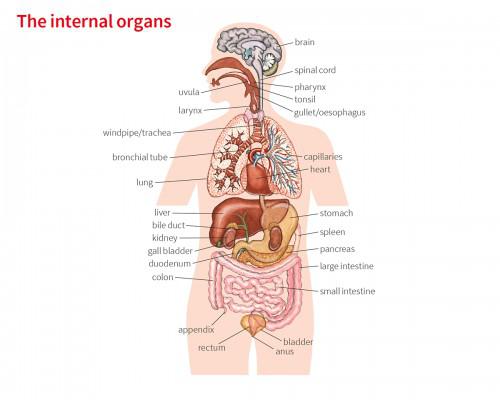
organe
a part of the body made of several tissues that performs a particular function, such as the heart or liver
The liver is the largest internal organ in the body.
Le foie est le plus gros organe interne du corps.
Severe sepsis can lead to multiple organ failure.
Synonymesbody partmemberinstrumentpublicationvehicleagencyAntonymeswholeentiretyinanimate objectcollagène
the main structural protein in skin, bone, tendons and other connective tissues
Tightly packed collagen fibers give tendons their great strength.
Les fibres de collagène très serrées donnent aux tendons leur grande résistance.
Collagen production in the skin decreases with age.
Synonymesproteinstructural proteinAntonymesNone (Collagen does not have a direct antonym. Focus is on things that degrade/inhibit it)tissu conjonctif
tissue that supports, connects and protects other tissues and organs, such as bone, cartilage, fat and tendons
Tendons and ligaments are made of dense connective tissue.
Les tendons et les ligaments sont constitués de tissu conjonctif dense.
Lupus is a disease that mainly attacks the connective tissue.
Synonymessupporting tissuebinding tissueAntonymesepithelial tissuenervous tissuemuscle tissuecytoplasme
the jelly-like material inside a cell, around the nucleus, where many cell activities take place
Many chemical reactions of the cell take place in the cytoplasm.
De nombreuses réactions chimiques de la cellule ont lieu dans le cytoplasme.
The stain colored the cytoplasm pink and the nucleus blue.
Synonymesprotoplasmcell substanceAntonymesnucleuscell membraneépithélium
the layer of cells that covers the body surface and lines organs, vessels and cavities
The epithelium of the airways is covered with tiny hairs called cilia.
L'épithélium des voies respiratoires est recouvert de minuscules cils appelés cils vibratiles.
Most cancers, such as skin and lung cancer, begin in the epithelium.
Synonymestissue liningsurface layercoveringAntonymesnoneglande
an organ or group of cells that produces and releases substances such as hormones, sweat or saliva
The thyroid gland produces hormones that control metabolism.
La glande thyroïde produit des hormones qui contrôlent le métabolisme.
Sweat glands in the skin help to regulate body temperature.
SynonymesorgannodeacinusAntonymesNonecellule souche
an unspecialized cell that can divide and develop into many different types of cell
Bone marrow contains stem cells that produce all types of blood cells.
La moelle osseuse contient des cellules souches qui produisent tous les types de cellules sanguines.
Researchers are testing stem cells to repair damaged heart muscle.
Synonymesprogenitor cellmother cellAntonymesdifferentiated cellspecialized cellmitochondrie
a tiny structure inside a cell that produces energy from food; the plural is mitochondria
Muscle cells contain many mitochondria because they need a lot of energy.
Les cellules musculaires contiennent de nombreuses mitochondries parce qu'elles ont besoin de beaucoup d'énergie.
Some rare inherited diseases are caused by faulty mitochondria.
SynonymespowerhouseorganelleAntonymesnonehoméostasie
the body's ability to keep its internal conditions, such as temperature and blood sugar, stable
The kidneys play a key role in maintaining fluid homeostasis.
Les reins jouent un rôle clé dans le maintien de l'homéostasie hydrique.
Severe illness such as sepsis can disturb the body's homeostasis.
SynonymesequilibriumstabilitybalanceAntonymesimbalanceinstabilitymembrane cellulaire, membrane plasmique
the thin outer layer of a cell that controls what enters and leaves it
Small molecules such as oxygen pass easily across the cell membrane.
Les petites molécules comme l'oxygène traversent facilement la membrane cellulaire.
Some antibiotics work by damaging the cell membrane of bacteria.
noyau, noyau cellulaire
the central part of a cell that contains its genetic material (DNA) and controls its activity
Red blood cells lose their nucleus as they mature.
Les globules rouges perdent leur noyau en arrivant à maturité.
Under the microscope, the cancer cells had large, dark nuclei.
organite, organite cellulaire
a small structure inside a cell that has a particular job, such as the nucleus or a mitochondrion
Each organelle performs a specific function within the cell.
Chaque organite remplit une fonction spécifique au sein de la cellule.
Electron microscopes allow us to see organelles in great detail.
tissu adipeux
body tissue that stores fat and helps to keep the body warm and protect organs
Adipose tissue is found under the skin and around internal organs.
Le tissu adipeux se trouve sous la peau et autour des organes internes.
Excess adipose tissue around the waist increases the risk of heart disease.
muqueuse
a moist layer of tissue that lines passages such as the mouth, nose and gut and produces mucus
The mucous membranes of her mouth looked pale and dry.
Les muqueuses de sa bouche paraissaient pâles et sèches.
Viruses often enter the body through the mucous membrane of the nose.