Ders 3/10 · 15 kelime · Öğrenilen: 0
Cells and tissues
Hücreler ve dokular
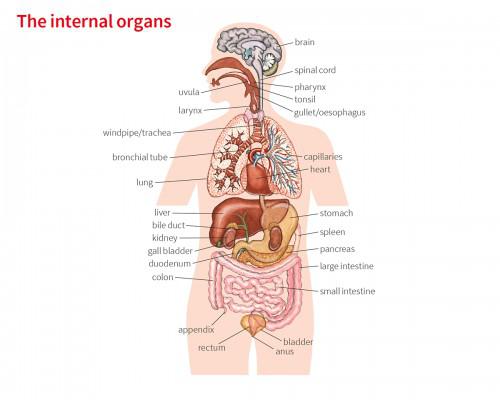
organ
a part of the body made of several tissues that performs a particular function, such as the heart or liver
The liver is the largest internal organ in the body.
Karaciğer, vücudun en büyük iç organıdır.
Severe sepsis can lead to multiple organ failure.
Eş anlamlılarbody partmemberinstrumentpublicationvehicleagencyZıt anlamlılarwholeentiretyinanimate objectkollajen
the main structural protein in skin, bone, tendons and other connective tissues
Tightly packed collagen fibers give tendons their great strength.
Sıkı paketlenmiş kollajen lifleri tendonlara büyük dayanıklılık kazandırır.
Collagen production in the skin decreases with age.
Eş anlamlılarproteinstructural proteinZıt anlamlılarNone (Collagen does not have a direct antonym. Focus is on things that degrade/inhibit it)bağ dokusu
tissue that supports, connects and protects other tissues and organs, such as bone, cartilage, fat and tendons
Tendons and ligaments are made of dense connective tissue.
Tendonlar ve bağlar yoğun bağ dokusundan oluşur.
Lupus is a disease that mainly attacks the connective tissue.
Eş anlamlılarsupporting tissuebinding tissueZıt anlamlılarepithelial tissuenervous tissuemuscle tissuesitoplazma
the jelly-like material inside a cell, around the nucleus, where many cell activities take place
Many chemical reactions of the cell take place in the cytoplasm.
Hücrenin kimyasal tepkimelerinin çoğu sitoplazmada gerçekleşir.
The stain colored the cytoplasm pink and the nucleus blue.
Eş anlamlılarprotoplasmcell substanceZıt anlamlılarnucleuscell membraneepitel, epitel doku
the layer of cells that covers the body surface and lines organs, vessels and cavities
The epithelium of the airways is covered with tiny hairs called cilia.
Solunum yollarının epiteli, silya adı verilen küçük tüylerle kaplıdır.
Most cancers, such as skin and lung cancer, begin in the epithelium.
Eş anlamlılartissue liningsurface layercoveringZıt anlamlılarnonebez
an organ or group of cells that produces and releases substances such as hormones, sweat or saliva
The thyroid gland produces hormones that control metabolism.
Tiroit bezi, metabolizmayı kontrol eden hormonları üretir.
Sweat glands in the skin help to regulate body temperature.
Eş anlamlılarorgannodeacinusZıt anlamlılarNonekök hücre
an unspecialized cell that can divide and develop into many different types of cell
Bone marrow contains stem cells that produce all types of blood cells.
Kemik iliği, tüm kan hücresi türlerini üreten kök hücreler içerir.
Researchers are testing stem cells to repair damaged heart muscle.
Eş anlamlılarprogenitor cellmother cellZıt anlamlılardifferentiated cellspecialized cellmitokondri
a tiny structure inside a cell that produces energy from food; the plural is mitochondria
Muscle cells contain many mitochondria because they need a lot of energy.
Kas hücreleri çok enerjiye ihtiyaç duydukları için çok sayıda mitokondri içerir.
Some rare inherited diseases are caused by faulty mitochondria.
Eş anlamlılarpowerhouseorganelleZıt anlamlılarnonehomeostazi, iç denge
the body's ability to keep its internal conditions, such as temperature and blood sugar, stable
The kidneys play a key role in maintaining fluid homeostasis.
Böbrekler sıvı homeostazisinin sürdürülmesinde önemli bir rol oynar.
Severe illness such as sepsis can disturb the body's homeostasis.
Eş anlamlılarequilibriumstabilitybalanceZıt anlamlılarimbalanceinstabilityhücre zarı, plazma membranı
the thin outer layer of a cell that controls what enters and leaves it
Small molecules such as oxygen pass easily across the cell membrane.
Oksijen gibi küçük moleküller hücre zarından kolayca geçer.
Some antibiotics work by damaging the cell membrane of bacteria.
çekirdek, hücre çekirdeği, nükleus
the central part of a cell that contains its genetic material (DNA) and controls its activity
Red blood cells lose their nucleus as they mature.
Alyuvarlar olgunlaştıkça çekirdeklerini kaybeder.
Under the microscope, the cancer cells had large, dark nuclei.
organel, hücre organeli
a small structure inside a cell that has a particular job, such as the nucleus or a mitochondrion
Each organelle performs a specific function within the cell.
Her organel hücre içinde belirli bir işlevi yerine getirir.
Electron microscopes allow us to see organelles in great detail.
yağ dokusu, adipoz doku
body tissue that stores fat and helps to keep the body warm and protect organs
Adipose tissue is found under the skin and around internal organs.
Yağ dokusu deri altında ve iç organların çevresinde bulunur.
Excess adipose tissue around the waist increases the risk of heart disease.
mukoza, mukoza zarı
a moist layer of tissue that lines passages such as the mouth, nose and gut and produces mucus
The mucous membranes of her mouth looked pale and dry.
Ağzındaki mukoza zarları soluk ve kuru görünüyordu.
Viruses often enter the body through the mucous membrane of the nose.