Lektion 3/10 · 15 Wörter · 0 gelernt
Cells and tissues
Zellen und Gewebe
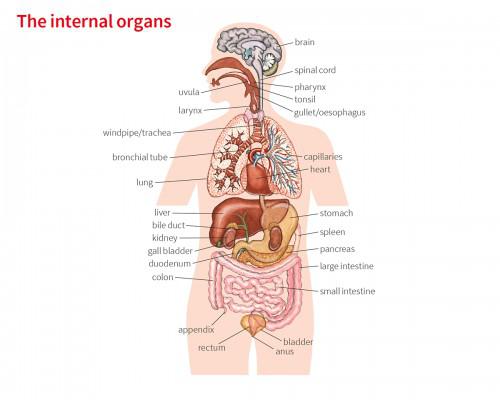
das Organ
a part of the body made of several tissues that performs a particular function, such as the heart or liver
The liver is the largest internal organ in the body.
Die Leber ist das größte innere Organ des Körpers.
Severe sepsis can lead to multiple organ failure.
Synonymebody partmemberinstrumentpublicationvehicleagencyAntonymewholeentiretyinanimate objectdas Kollagen
the main structural protein in skin, bone, tendons and other connective tissues
Tightly packed collagen fibers give tendons their great strength.
Dicht gepackte Kollagenfasern verleihen den Sehnen ihre große Festigkeit.
Collagen production in the skin decreases with age.
Synonymeproteinstructural proteinAntonymeNone (Collagen does not have a direct antonym. Focus is on things that degrade/inhibit it)das Bindegewebe
tissue that supports, connects and protects other tissues and organs, such as bone, cartilage, fat and tendons
Tendons and ligaments are made of dense connective tissue.
Sehnen und Bänder bestehen aus straffem Bindegewebe.
Lupus is a disease that mainly attacks the connective tissue.
Synonymesupporting tissuebinding tissueAntonymeepithelial tissuenervous tissuemuscle tissuedas Zytoplasma
the jelly-like material inside a cell, around the nucleus, where many cell activities take place
Many chemical reactions of the cell take place in the cytoplasm.
Viele chemische Reaktionen der Zelle finden im Zytoplasma statt.
The stain colored the cytoplasm pink and the nucleus blue.
Synonymeprotoplasmcell substanceAntonymenucleuscell membranedas Epithel, das Epithelgewebe
the layer of cells that covers the body surface and lines organs, vessels and cavities
The epithelium of the airways is covered with tiny hairs called cilia.
Das Epithel der Atemwege ist mit winzigen Härchen, den Zilien, besetzt.
Most cancers, such as skin and lung cancer, begin in the epithelium.
Synonymetissue liningsurface layercoveringAntonymenonedie Drüse
an organ or group of cells that produces and releases substances such as hormones, sweat or saliva
The thyroid gland produces hormones that control metabolism.
Die Schilddrüse bildet Hormone, die den Stoffwechsel steuern.
Sweat glands in the skin help to regulate body temperature.
SynonymeorgannodeacinusAntonymeNonedie Stammzelle
an unspecialized cell that can divide and develop into many different types of cell
Bone marrow contains stem cells that produce all types of blood cells.
Das Knochenmark enthält Stammzellen, aus denen alle Arten von Blutzellen entstehen.
Researchers are testing stem cells to repair damaged heart muscle.
Synonymeprogenitor cellmother cellAntonymedifferentiated cellspecialized celldas Mitochondrium
a tiny structure inside a cell that produces energy from food; the plural is mitochondria
Muscle cells contain many mitochondria because they need a lot of energy.
Muskelzellen enthalten viele Mitochondrien, weil sie viel Energie benötigen.
Some rare inherited diseases are caused by faulty mitochondria.
SynonymepowerhouseorganelleAntonymenonedie Homöostase
the body's ability to keep its internal conditions, such as temperature and blood sugar, stable
The kidneys play a key role in maintaining fluid homeostasis.
Die Nieren spielen eine zentrale Rolle bei der Aufrechterhaltung der Flüssigkeitshomöostase.
Severe illness such as sepsis can disturb the body's homeostasis.
SynonymeequilibriumstabilitybalanceAntonymeimbalanceinstabilitydie Zellmembran
the thin outer layer of a cell that controls what enters and leaves it
Small molecules such as oxygen pass easily across the cell membrane.
Kleine Moleküle wie Sauerstoff passieren die Zellmembran problemlos.
Some antibiotics work by damaging the cell membrane of bacteria.
der Zellkern, der Nukleus
the central part of a cell that contains its genetic material (DNA) and controls its activity
Red blood cells lose their nucleus as they mature.
Rote Blutkörperchen verlieren bei der Reifung ihren Zellkern.
Under the microscope, the cancer cells had large, dark nuclei.
das Organell, die Zellorganelle
a small structure inside a cell that has a particular job, such as the nucleus or a mitochondrion
Each organelle performs a specific function within the cell.
Jedes Organell erfüllt eine bestimmte Funktion innerhalb der Zelle.
Electron microscopes allow us to see organelles in great detail.
das Fettgewebe
body tissue that stores fat and helps to keep the body warm and protect organs
Adipose tissue is found under the skin and around internal organs.
Fettgewebe findet sich unter der Haut und um die inneren Organe.
Excess adipose tissue around the waist increases the risk of heart disease.
die Schleimhaut
a moist layer of tissue that lines passages such as the mouth, nose and gut and produces mucus
The mucous membranes of her mouth looked pale and dry.
Die Mundschleimhaut der Patientin wirkte blass und trocken.
Viruses often enter the body through the mucous membrane of the nose.